 |
| The Duke Engine |
The Duke Engine is an Advanced Internal Combustion Engine delivering high Thermodynamic Efficiency, complete Fuel Flexibility, (runs on any suitable spark ignition fuel),Neglible 1st and 2nd order Vibration with huge Weight and Size savings.
It is a considerably less complex internal combustion engine and is suitable forMarine (inboard and outboard), Light Aircraft, Generator/Utility and Military applications.
TECHONOLOGY
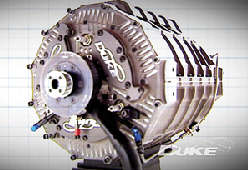
Duke Engines are in an advanced stage of developing a unique high-speed, valve-less 5 cylinder, 3 injector axial internal combustion engine with zero first-order vibration, significantly reduced size and weight, very high power density and the ability to run on multiple fuels and bio-fuels. The Duke engine is suited for many uses including marine, military, automobile, light aircraft and range extender applications.
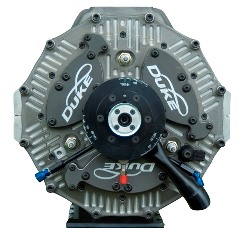 |
| intake manifoulde |
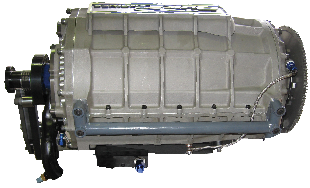 |
| Side view |

 The Duke Engine features many technology breakthroughs. The Duke's unique counter rotation, 3 dimensional, almost vibration free motion and the innovative methodology employed to achieve this, addresses previous limitations that have prevented the commercialization of axial piston engines to date, especially at higher power and speed.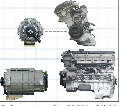
The Duke Engine delivers huge weight and size savings. In comparisons made to conventional IC engines with similar displacement, the Duke engine was found to be up to 19% lighter and up to 36% smaller.
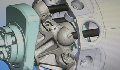 The Duke Engine has negligible 1st-order or 2nd-order Vibration. The Duke’s nutating reciprocator leads to very low angles of con rod articulation resulting in a near sinusoidal reciprocating motion. This combined with the counter-rotating cylinder group and crankshaft in the Duke engine delivers near perfect mechanical balance resulting in a very low vibration engine.
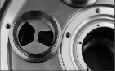 The Duke Engine delivers high thermodynamic efficiency. The absence of hot valves in the favorably shaped combustion chamber allows high compression ratios for efficient operation on low octane fuels. With only 3 exhaust headers for 5 cylinders there is a low surface area for heat loss prior to any catalytic converter, offering a potential catalyst light-off benefit.
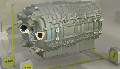 The Duke offers designers greater freedom. Duke’s axial geometry creates a very compact cylindrical package, allowing for a wide range of design applications, limited space fit, aerodynamic optimization and ease of installation.
 The Duke Engine offers wide fuel flexibility. The current engine can be run on any suitable spark ignition fuel. Kerosene/Jet A1 operation has been successfully tested. It is expected with further development to be able to operate on all appropriate fuels, including Ethanol/Methanol and blends, Bio ethanol, LPG, CNG, Hydrogen, Kerosene and Diesel.
 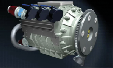 The Duke Engine is far less complex than traditional IC engines. The Duke engine's lower component count (only 3 sets of injectors and ports for 5 cylinders with no valve train), coupled with potentially lower production costs, make for savings in manufacturing and operation. And the Duke uses existing materials and manufacturing processes in its construction.
Duke Engines is committed to Research & Development, with further advances already underway. The Duke is currently in its 3rd generation running prototype. The engine has been successfully tested at University of Auckland and Mahle UK & USA dynamometers and test facilities, (data available), with systems co-development by expert UK partners. Duke Engines’ mechanical systems innovations can be developed beyond the engine platform to pumps, gearboxes etc.
The Duke Engine has IP protection. Throughout the development process, Duke Engines has filed patent applications to protect its technology.
 Duke Engine Financial Supporters. In addition to the initial founders inputs, Duke Engines has enjoyed support financial and otherwise from New Zealand Trade & Enterprise, TechNZ, Ministry of Science and Innovation and private investors including the Gallagher Group.
Duke Engines - the Future. Duke Engines is now at a third generation of the engine and currently developing the next generation of the technology, including running with kerosene and biofuels and exploring the unique design characteristics of the Duke engine to allow Variable Compression Ratios.
Duke Engines is actively seeking partners right now to join in developing this visionary technology around application specific parameters.
Duke Engine


